Wednesday, October 17, 2012

A Brief History Of “Trickle-Down Government” | The New Republic

In the presidential debates, Mitt Romney keeps talking about "trickle-down government." At the first debate in Denver, Romney said, "The president has a view very similar to the view he had when he ran four years [ago], that a bigger government, spending more, taxing more, regulating more--if you will, trickle-down government--would work." At the second debate in Long Island, Romney elaborated:

This is the way we're going to create jobs in this country. It's not by trickle-down government, saying we're going to take more money from people and hire more government workers, raise more taxes, put in place more regulations. Trickle-down government has never worked here, has never worked anywhere.

Both times, I found myself wondering what the hell Romney was talking about. I don't mean that in the rhetorical sense. I mean literally I had no idea what the phrase "trickle-down government" was supposed to mean. How is "trickle-down government" different from, well, government?

The provenance of the phrase is awkward for Romney. The first use of "trickle-down government" that I can find on Nexis was in an Associated Press report from July 1984. It wasn't at all pejorative about government spending--if anything, it was favorable--and the context was an argument being made by the management of the Los Angeles Olympics, led by Romney's fellow Republican and fellow Olympics-savior-turned-political- candidate Peter Ueberroth. (Ueberroth would wage an unsuccessful campaign for California governor in 2003, running as an independent.)

The phrase appears within the AP reporter's paraphrase of the L.A. Olympic committee's argument (perhaps made by Ueberroth, perhaps made by someone else, but certainly consistent with what Ueberroth is quoted saying in the story) that $88 million in previously-unacknowledged federal subsidies for the games would be money well spent. The committee, AP reported, "has countered [arguments that U.S. taxpayers were getting ripped off] that the Games will generate millions in direct taxes and indirect, trickle-down government revenues." In this context, then, "trickle-down government" is shorthand for government spending that has a stimulative multiplier effect on private-sector economic growth. Romney's 2002 Salt Lake City Olympics, incidentally, ended up costing the federal government $342 million, which (after inflation) was two and a quarter times as much trickle-down government Keynesian stimulus as the $88 million described in the 1984 story.

Something very like the phrase "trickle-down government" is also used in a 1990 Newsday story. Here it's pejorative, but its meaning is to criticize the bait-and-switch devolution of government functions to state and local governments, which of course Romney very much favors:

New York and other older cities are suffering the most from the "trickle down" of government responsibility from the federal to the local level, notes Rae Rosen, an economist with the Federal Home Loan Bank of New York. On top of everything else, city residents must now put up with tax increases and cutbacks in services and the "privatization of services" they used to take for granted, such as public schools, neighborhood security and even mail delivery. In other words, after paying more for less government, New Yorkers must shell out even more to live here.

Sen. Chuck Robb, D.-Va., uses the phrase "trickle-down government" to describe similar buck-passing in a 1991 speech to the National Association of Counties, though here there is also a hint that the ultimate fault might lie with the federal government for imposing burdensome mandates:

When your states are loaded up with new responsibilities and no way to pay for them, they usually play bucket brigade themselves and dump hand-me-down mandates on the counties and municipalities.
For example, I spoke Friday night in Rensselaer County, New York. In that country, almost 88 percent of the county budget is driven by state mandate, many of which are thoughtfully passed along from the federal hand-offs. That you might describe as trickle-down government at its worst. Some have even called it trickle-on.

The first attributed usage of the term "trickle-down government" in something like the way Romney seems to mean is in 1988, when the perpetually unsuccessful Republican political candidate Alan Keyes used it against Maryland Sen. Paul Sarbanes, against whom he was running, in a political debate. "Keyes said Sarbanes wants a form of trickle down government," Robert Barnes reported in the Washington Post, "where power is vested in big government and the benefits filter down 'through an intolerably complicated system' to reach those at the bottom." While Barnes does not put "trickle-down government" in quotation marks, it seems probable from the context that Keyes used that phrase or something very like it in the debate. So I'm going to go out on a limb here and attribute the coinage of "trickle-down government" in the sense Romney means it (whatever that may be) to Keyes. Keyes, of course, would go on to lose a Senate race 16 years later, in the entirely different state of Illinois, to Barack Obama.

In 1992, the phrase "trickle-down government" was used in its Keyesian-not-Keynesian sense by, of all people, Democratic presidential candidate Bill Clinton, in a speech to the National Association of Manufacturers. Rival primary candidate Paul Tsongas, you may recall, nicknamed Clinton "pander bear," and pandering does indeed seem to have been Clinton's motive here. "We need to reduce the amount of government spending by the government," Clinton said. "I'm just as against trickle-down government as I am trickle-down economics. I want to give that money back to people at the grassroots level to invest in America."

I find no evidence that Clinton ever uttered the phrase again (though Vice President Gore would later make use of it in his "reinventing government" crusade), but the 1992 Republican party platform said, "The Democrats are trapped in their compact with the ideology of trickle-down government, but they're clever enough to know that the voters would shun them if their true markings were revealed." This was a prelude to celebrating America's "rendezvous with destiny in 1980. Faced with crisis at home and abroad, Americans turned to Republican leadership in the White House. Presidents Reagan and Bush turned our Nation away from the path of over-taxation...." Some would call that trickle-down economics.

In that year's vice-presidential debate, Al Gore asked Dan Quayle, "How much longer will it take, Dan, for trickle-down economics to work in your theory?" Quayle replied: "Well, you--we're going to have plenty of time to talk about trickle-down government, which you're for." I'm rubber, you're glue, bounce off me and stick to you!

A similar exchange subsequently occurred in a presidential debate between Clinton and George H.W. Bush. "My plan is a departure from trickle-down economics," Clinton said. "I don't believe trickle-down economics will work." The elocutionally-challenged Poppy Bush replied, "He doesn't like trickle-down government, [he meant "trickle-down economics"] but hey, I think he's talking about the Reagan-Bush years where we created 15 million jobs....What I don't like is trickle-down government [second time's the charm]. I think Governor Clinton keeps talking about trickle-down, trickle-down, and he's still talking about spending more and taxing more." Bush apparently liked the phrase "trickle-down government" a lot, because from then on he used it frequently on the campaign trail. Eventually, of course, Bush lost. After that, the phrase fell mostly into misuse until Romney revived it earlier this month.

To judge from its history, "trickle-down government" is a phrase whose focus-group-tested function has less to do with any inherent meaning than with neutralizing (or, in Clinton's case, balancing out) the phrase "trickle-down economics," i.e., tax cuts for the rich. Keyes first introduced the phrase (or at least the idea) to counter Sarbanes' use of the phrase "trickle-down economics." Romney, in the first debate, said "trickle-down government" only after first disputing that he was for "top-down, cut taxes for the rich. That's not what I'm going to do." (Uh, yes it is. But never mind that for now.)

To the very minor extent that "trickle-down government" has any meaning at all, it's shorthand for the argument, "Government spending doesn't stimulate the economy." But even that is just a reflexive attempt to neutralize the argument (backed by powerful evidence) that tax cuts for rich people don't stimulate the economy. Indeed, to whatever extent they exacerbate income inequality, the growing consensus is that they may harm it.

The idea that government spending doesn't help the economy contradicts a pretty sturdy consensus among economists (including, according to Paul Krugman, at least two of Romney's own economic advisers, Greg Mankiw of Harvard and Glenn Hubbard of Columbia) that government spending does indeed stimulate the economy, just like John Maynard Keynes said. Indeed, in times of economic crisis government spending (along with Fed monetary policy, which the president and Congress don't control) is just about the only tool the government has at its disposal. Romney claims not to believe this. But if he really doesn't believe it, where is his apology for wasting the government's money at the 2002 Winter Olympics?

A Brief History Of “Trickle-Down Government” | The New Republic

Friday, September 11, 2009

Health care reform needs a heath check.

In the never ending debate the best and most pragmatic opinion offered is by Dr. Andrew Weil, M.D. The number one "New York Times" best-selling author. He wrote "Healthy Aging."

From last night's larry king live:

WEIL: OK. First of all, we don't have a health care system in this country, we have a disease management system that's horribly dysfunctional and getting worse by the day. And the vast majority of disease that we're trying to manage is lifestyle related and, therefore, preventable.

So what we really need to do is to shift our energies away from disease management toward making people healthy and preventing them from getting sick. And that means that I think a society wide effort of -- of everyone pulling in the same direction. You can't have the government telling us to eat more fruits and vegetables and at the same time, through its subsidy program, ensuring that fruits and vegetables are the most expensive things in grocery stores and all the unhealthy stuff is the cheapest. You know, everything has to work together here.

Secondly, the kinds of interventions that we're using to treat disease are way too expensive because they're dependent on technology. I include pharmaceuticals in that. We need a new kind of medicine in which doctors know how and patients accept low tech, high touch approaches to the treatment of illness.

Some immediate things. I would immediately ban direct to consumer advertising of pharmaceutical drugs. That's been a disaster for patients and doctors and a great boon to the drug companies. No other company -- no other country in the world allows that except New Zealand. Stop that right away.

Secondly, I'd set up an office...

KING: And what else?

WEIL: I'd set up an office of health education in the Department of Education with adequate funds to get serious about K through 12 health education, starting with teaching kids about what health is and what lifestyle choices promote it. I think education is something that we could really be serious about.

You know, I heard the president last night talk about prevention very briefly. And he talked about mammograms and colonoscopies. To me, that is such a superficial aspect of prevention. You know, the meat of prevention is about teaching people how to make the right choices about food, how to keep your body physically active, how to deal with stress.

Friday, May 29, 2009

American public Media:Celeb tweets help push Anvil to success

Interesting story had to share this:

 http://marketplace.publicradio.org/display/web/2009/05/28/pm_anvil_q/

Celeb tweets help push Anvil to success

Screen shot from 'Anvil! The Story of Anvil'

Claude Brodesser Akner, L.A. bureau chief for Advertising Age, talks with Kai Ryssdal about how heavy metal band Anvil managed to rock its way to the top through a documentary and support from a cable channel, celebrities and Twitter.

Kai Ryssdal: I'm going to go way out on a limb here and guess that not too many of you have heard of a 30-year-old Canadian thrash metal band called Anvil. Lots of heavy metal groups you probably do know really respect 'em, though. They inspired bands like Guns-N-Roses and Metallica. Malcolm Dome writes for a magazine called Metal Hammer.

MALCOLM DOME: If you actually had to choose one band and one album that really started the whole ball rolling, it would be "Metal on Metal" and it would be Anvil.

'Who could like Cactus?' -- Clip from 'Anvil! The Story of Anvil'
(AnvilTheMovie / YouTube)

Catchy tune, I know, but Anvil somehow never really got off the ground. Now, though, on the strength of a new documentary -- we pulled that Malcolm Dome cut from it -- the band is enjoying the success their fans say is long overdue. It's a turnaround they can credit to a struggling cable channel, a couple of popular recording artists, and everybody's favorite new social-media site. Claude Brodesser Akner is the L.A. bureau chief for Advertising Age magazine. And when we sat down to talk about this I asked him how a documentary about thrash metal could possibly stand a chance.

CLAUDE BRODESSER AKNER: This movie has two bullets in the head right from the start. It's a documentary and thrash medal. I mean, so right there it's got its hurdles. On top of that, it has no studio support, for probably the reasons we just articulated.

'Good Management' -- Clip from 'Anvil! The Story of Anvil'
(AnvilTheMovie / YouTube)

Ryssdal: All right, well then how is this film succeeding, to the degree it is, without any major studio support?

AKNER: Well, what happened was this: VH1 purchased the broadcast television and DVD rights to "Anvil! The Story of Anvil," which is this documentary. And so while they are not in any way sort of responsible for the theatrical release, they are heavily incentivized to make sure it's a successful one.

Ryssdal: Incentivized in what way?

AKNER: Because the better it does in theaters, the better it does on DVD.

Ryssdal: All right, so how do they make it work, then?

AKNER: They started handing it out on a DVD to various VHI stars. John Mayer, people like Joel and Benji Madden from Good Charlotte. And these are people who have tremendous followings on Twitter, which is the free social-networking...

Ryssdal: One-hundred-forty characters or less...

AKNER: Exactly. And had you purchased the kind of exposure that they have through Twitter, you would have spent many, many, many hundreds of thousands of dollars.

Ryssdal: Let me get make sure I have this right. What VH1 did was distribute these free copies to these music stars who have Twitter accounts. The hope being that they would then Twitter, their followers would re-tweet, and go see the movie, and everything would sort of happen. Total cash out of pocket to VH1 is probably, like, 20 bucks for making the DVDs, right?

AKNER: If that much. There's no real way to quantify the value of Twitter media. That is, when you buy a banner ad on RollingStone.com, you know you're going to get X-many impressions. But it's just not the same thing as someone who you follow and maybe are deeply, deeply interested in. When they tweet something, that's like a tap on the shoulder.

Ryssdal: Is there anything in this for the tweeters. I mean, are John Mayer and those guys getting a little extra air play time from VH1 for doing this?

AKNER: No, and in fact, VH1 has been very, very, very, very -- I underline that five times -- assiduous about emphasizing that this can blow up in your face. That you cannot do this sort of thing for "I Love New York" or some sort of Flavor Flav show. Nor can it seem as though these people have been given blandishments to tweet. This has been a sort of spontaneous, earned-media experience rather than a media buy.

Ryssdal: So are people at the major studios sitting there going, Hmmm....VH1 did this, I wonder if it could work for us?

AKNER: Well, if Twitter winds up becoming the sort of cream-skimming device for smaller cultural happenings, that's a very interesting model. Because Hollywood has pretty much all but abandoned the serious documentary film, or the serious art film.

Ryssdal: What about the traditional documentary audience, though? Which I would imagine skews older, isn't necessarily online, doesn't necessarily tweet.

AKNER: You don't have to worry about making sure people over 50 go see a documentary. In a sense that's the low-hanging fruit. I was talking to Bingham Ray who was really the first executive to market successfully a major documentary -- and that was "Bowling for Columbine," which made $20 million. He said, you know we could have made millions more had we spent millions more. But there's a point of diminishing returns on documentaries. And for this film, I'm kind of actually hoping that they don't wind up spending any television money because this would be the case study to find out what's a tweet really worth?

Ryssdal: Claude Brodesser Akner is the L.A. bureau chief for Advertising Age magazine. Claude, thanks a lot.

AKNER: Kai, it's a pleasure.

Ryssdal: Fittingly, we go out with Anvil playing "Metal on Metal."

Blogger Labels: Twitter,Story,AnvilTheMovie,VH1

Technorati Tags: ,,,,,,,

Thursday, May 7, 2009

Hmmmm……oh Ya the Great Indian Elections Drama…Forgot to post last week.

Every Indian general elections brings more people to the polls than the last and hence it has been beating it’s own turnout records since 1964. I found a blog by noted Indian Journalist Vikas Singh:The real final: Rahul vs Modi : Rue-Barb Pie : Vikas Singh - Times Of India Blog which adequately describes the current general elections in India.

If someone wonders how the caste system came into place in India, he or she can just look at India’s history since Independence. Casteism  is as Indian as say the river Ganges. Hence we have new castes of political families, Bollywood families, Industrialist families etc who have been formed just by biological relations. They have all the endogamous and hereditary social group barriers which are typical of the Indian caste system.

The Political caste of India currently has a few major families. The main one being the Gandhi (not M.K Gandhi but related to his protégé Jawaharlal Nehru) and some others of prominent political leaders since Independence.

All current polls and market buzz indicate this election will not bring clear majority to any party but a coalition of the congress( the Gandhi Family) might form the next Government.

So why does one have to care about the results? Well apart from the Importance of India to the Global economy, it being a major regional military power etc, the real reason which is to foresee any radical shifts in Indian economic and foreign policies and what impact these heirs of their respective parties are going to have in present elections.

Technorati Tags: ,,,,,,,,,,,,,,,,,,,,,,,,,,,,,,,,,,,

A Lesson in Social media: Article on how McGraw-Hill Learning Group Uses Viral Video and Online Forum to Build Customer Relationships

Through the vibrant network of social media, McGraw-Hill Education and McGraw-Hill Learning Group (MHLG) are developing innovative ways to reach educators in a multimedia landscape by integrating video with interactive networking sites. “Teachers are turning regularly to online video and social networking sites,” explains Mark Merz, product manager, Direct Instruction,

MHLG ,“to bolster classroom instruction with multimedia examples, share and request teaching advice and learn about new products being offered by publishers.” MHLG is responding to customers’ needs by posting informational and promotional videos on free sites like YouTube and Teacher-Tube, garnering hundreds and sometimes thousands of views. Topics range from brief clips of MHLG programs being taught in real classrooms to recorded Webinars on broader educational subjects. These online video clips accumulated more than 40,000 views from January 2008 to January 2009, increasing MHLG’s exposure in the marketplace and to its customers. In 2008 MHLG’s SRA experienced a 27 percent overall increase in online revenue, and Direct Instruction product online sales jumped more than 37 percent —an increase of more than $1million, despite the economic downturn.

A Professional Network for Educators

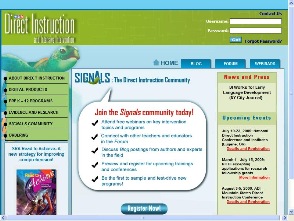
MHLG, through SRA,has further reinforced its relationships with customers by creating an online community for educators specializing in Direct Instruction (DI), called Signals. “The Signals community hosted on SRADirectInstruction.com currently has over 1,000 registered members,” Mr.Merz says, “including school directors and administrators, teachers, McGraw-Hill sales representatives, and even some parents. Signals is helping SRA to expand its customer base and solidify its role as the primary provider of products, information, and support for the Direct Instruction teaching method.” In addition to a feed of current news articles and a list of upcoming events, the community also includes an informative blog, user forums and a section for viewing video content. Signals community members can post questions, request information, share best practices and network. SRA not only provides answers and tools to educators, but creates a space in which they can share advice and proven methods with each other: “Forums allow potential customers to post product- or support-related questions and receive e-mail notifications when their questions are responded to. Community members who are strong MHLG product advocates often respond directly to questions posted in our forums, creating an additional level of viral, customer-driven product support that would otherwise not be available, ”Mr.Merz says. The benefit is mutual, as customers’ suggestions for improving products are more regularly being brought up in product development discussions. MHLG’s outreach through social media makes the connection between government funding trends, educational movements and real-world teachers’ and students’ requirements. Equally as important, it connects the people, purpose and products that will keep the Corporation thriving and America’s new generation achieving. _

“Signals is helping SRA to expand its customer

base and solidify its role as the primary

provider of products, information, and support

for the Direct Instruction teaching method.”

— Mark Merz, product manager, Direct Instruction, MHLG

Article Source: The McGraw-Hill Companies.

Technorati Tags: ,,,,,,,,,,,,,,,,,,,,,,,,,,,,,,,,,,,,,,,,,,,,,,,,,,,,,,,,,,,,,,,,,,,,,,

Friday, April 24, 2009

21st century Challenges from lawlessness: Piracy and the Taliban.


Two major news items caught my attention this week. It wasn't; like these were the only ones :) These were

a. More Ships hijacked by Somali pirates

b. Taliban getting awfully close to Islamabad, Pakistan.

In a way both these developments are remarkably similar.

Piracy is in essence a law and order issue, and in Somalia there is virtually no authority to carry out the kind of policing that could effectively disrupt pirate operations. What government there is in Somalia has bigger problems. Somalia has spent almost 20 years in a state of civil war, and shifting alliances, international interventions and a steady supply of unemployed young men and cheap guns have acted against any tendencies towards stabilization.

In Pakistan deep structural problems have created fertile ground for the Talibanization of Pakistan. I recommend reading The Idea of Pakistan by Stephen P. Cohen.

I am fortunate to have friends from Pakistan. Many a times we feel “PAKISTAN” the country is a problem. The problems are pretty basic: poverty, the lack of education, the seemingly imperatebilty OF exclusiveness.

The politics of extremism as represented by the Taliban, the economic meltdown and demographic pressure all point to a major implosion in Pakistan. Are we ready for the fallout?

Technorati Tags: ,,,